Sunday, February 22, 2009

Pakistan Military History


Columnist A H AMIN makes a case study of Indo-Pak Wars.
India and Pakistan have fought three declared wars and many undeclared wars of proxy or low intensity wars. This article is a brief analysis of the essence of these wars at the strategic and operational level.
1947-48 Kashmir War
The 1947-48 War was an improvised war fought on an ad hoc basis. It began with some tangible operational strategy and little definite strategy on the Pakistan side and a definite operational strategy on the Indian side. At the onset Mr Jinnah the Governor General of Pakistan ordered the British Acting C in C Pakistan Army to order two brigades into Kashmir, one on the Sialkot-Jammu Axis and the other on Murree-Muzaffarabad-Srinagar-Axis. This was a tangible plan based on a precise strategy of severing Indian landward and aerial lines of communication to Kashmir. The plan was rendered null and void since the Britisher refused to obey Jinnah’s order.
This was followed by a hastily scrambled series of actions with regular Pakistan Army officers leading irregulars, irregulars besieging Indian/Dogra garrisons and conducting mini-wars against Chamb, Naushera, Srinagar, Skardu, Leh etc. In April 1948 the regular Pakistan Army entered the scene. At this stage the Indians were in a strategically disadvantageous position. Leh being cut off, Poonch besieged, Skardu besieged, Naushera threatened etc. At this stage the Pakistani strategy was to contain Indian Army advance towards Muzaffarabad, capture Poonch and safeguard Pakistan’s soft underbelly opposite Gujrat. No one at this stage thought of a ceasefire, which would have been of great strategic advantage to Pakistan. The Indians conceived a fine plan to outflank Muzaffarabad and executed a brilliant brigade level march across against the 3,000 metres plus high Nastachun Pass, thus unexpectedly forcing their way with great ease to Tithwal. The Pakistani official history noted “Brigadier Harbux Singh, commander of the 163 Brigade waited at Tithwal for two days to let the rest of his brigade join him there . He lingered a little longer to prepare for his next move and perhaps also to coordinate his moves with that of the Indian offensive in the Jhelum Valley for a two pronged push towards Muzaffarabad. This delay changed the subsequent course of history in Kishanganga Valley, as it enabled the first two companies of 4/16 Punjab under Major Mohammad Akbar Khan to reach by a forced march in the vicinity of Tithwal and take up positions there”1. The Pakistanis saved their position by reinforcing it with a brigade.
On the operational level the Pakistanis did well by capturing Pandu a position of tactical importance in the Jhelum Valley by a brilliant infiltration plan conceived by Commander 101 Brigade Brigadier Akbar Khan DSO with the indomitable Major Ishaq MC as his Brigade Major. Akbar deputed Lt Col Harvey Kelly, commanding 4/10 Baluch to plan the attack in detail.2 Pandu, however, was an operational episode of great tactical significance but limited strategic value.
From April 1948 to December 1948 the Pakistani GHQ merely reacted tactically moving companies and battalions while the Indians moved strategically. In Phase One, they recaptured Rajauri the gateway to Poonch with a single tank squadron! In Phase Two, they achieved two strategic triumphs! They forced their way through Zojila Pass driving on to relieve Leh and capture Kargil Dras and they relieved Poonch which was a mini-Indian East Pakistan surrounded from all sides by Pakistani troops.
At this stage the Pakistani GHQ had conceived the Operation Venus. Venus was a thrust against the Indian line of communication leading to Poonch Valley with an infantry and a heavy tank brigade in Naushera-Beri Patan area. At this stage the Indians were involved in the relief of Poonch and Leh and strategically off balance. The official account of 1970, however, maintains that the aim of Venus was not to sever the Indian line of communication to Poonch but merely to force the Indians for ceasefire which they did and which came into effect on night 31 Dec 1948/01 January 1949. If ceasefire was the aim then the Pakistani strategy was barren since a ceasefire in July 1948 would have been far more strategically desirable! This was so since in April 1948 Zojila (captured by Gilgit Scouts under Lieut Shah Khan on 7th July 1948) the gateway to Srinagar as well as Ladakh in Pakistani hands, the frontline near Rajauri and Poonch surrounded by Pakistani troops/irregulars. It is not clear what the Pakistani GHQ advised the civilians at this stage but no records have been made public which prove that they gave any advice!
In the 1960s General Fazal-i- Muqeem asserted that the ceasefire of 1948 took place to the army’s horror since the army was close to a great victory. However, this point is refuted by the Pakistan Army’s Official account of 1970. Much later in 1976 General Sher Ali who was commanding a brigade of the Venus Force asserted that had the operation been launched Pakistani tanks would have been in Jammu within no time! This has to be taken with a pinch of salt once we compare it to the performance of armour in an offensive role in 1965 and 1971!
The Kashmir War ended with the Indians as masters of Poonch Valley, Srinagar Valley and Leh Valley but with a communication to all three valleys running precariously close to the Pakistani border! Thus strategically the Indian position despite all their strategic triumphs was not secure since their line of communications offered multiple objectives to any single Pakistani thrust. One tank brigade with a twenty mile thrust could threaten the existence of a whole Indian army corps. The Indians took no care to remedy this state of affairs despite many war games held in their Kashmir Corps to show that the Pakistanis could threaten the Indian line of communication in Poonch Valley.3
1965 War
The 1965 War was a comical affair! Civilians at the foreign ministry assessed that the Indians could be knocked out at the strategic level while soldiers at the highest military level and political level, the president being a soldier were not interested in any military adventure. The civilian hawks led by Bhutto, however, were in league with a group of generals and brigadiers within the army and finally succeeded in persuading the president
(famous for tactical timidity in Burma) into embarking on a military adventure. Musa the army chief had little strategic insight and was against any military adventure in which he may be forced to exercise his qualities of leadership! Musa had rudimentary understanding of strategy and tank warfare since he was a political choice appointed more because he was seen as politically no threat rather than for any military strategic or operational talent!
The Pakistani offensive plan i.e. a thrust against Indian line of communication at Akhnur in case of a limited war in Kashmir or/and against Indian line of communication between Indian Corps holding Ravi-Sutlej Corridor at Jandiala Guru on Amritsar-Jullundhur road in case of an all out war was brilliant in conception. This was so because if successful any of the two plans would have forced the Indians to sue for peace at best and to surrender at worst. No less an authority than the Indian Western Command C in C Harbaksh Singh thus confessed
“A Blitzkrieg deep into our territory towards the Grand Trunk Road or the Beas Bridge would have found us in the helpless position of a commander paralysed into inaction for want of readily available reserves while the enemy was inexorably pushing deep into our vitals. It is a nightmarish feeling even when considered in retrospect at this stage”.
To the Pakistan Army’s misfortune a plan which was brilliant at the strategic and operational level failed simply because those who were leading the military machine at the highest level lacked the strategic insight as well as resolution! The first opportunity was thus missed in Chamb-Jaurian Sector, when even a foreigner i.e. Chinese Foreign Minister visiting Pakistani thought that Akhnur5 was the key!
The second and most serious operational failure occurred in Khem Karan.This had more to do with poor execution at the divisional and brigade level and poor initial higher organization and composition of troops at the divisional level. The first being an operational failure and the second being an organizational failure at the higher command level.
At the operational and tactical level three events stand out in the war i.e. the Grand Slam Operation in Chamb-Jaurian, blunting of Indian offensive at Chawinda at Gadgor on 8th September when one lone tank regiment gave a severe mauling to two tank regiments out of a total available Indian force of an armoured division, and a brigade level counter attack in Lahore Sector.
Grand Slam failed because of change of command! Not because Akhtar Malik was better than Yahya but because one man either Akhtar or Yahya should have conducted the whole operation! The Indians admitted that their position was saved because of the pause of 48 hours, which occurred at Tawi after the Pakistani Chief Musa ordered change of horses in the mid stream!
Now the battle of Gadgor. Technically Gadgor was 24 Infantry Brigade Group versus 1st Indian Armoured Division. In reality the contest was 25 Cavalry versus Poona and Hodsons Horse since 24 Brigade Commander told Colonel Nisar to “do something”6 the vaguest order of 1965 War! Nisar had no idea of what was in front but by a miraculous coup d oeil deployed his tank regiment 25 Cavalry in a manner which would produce an instant nervous breakdown in an instructor who taught tank tactics at the armour school! 25 Cavalry was deployed by Nisar like a thin line of steel! Like a thin net to catch a whale! The manoeuvre if it can be called one succeeded because the Indian brigade commander was paralysed by the fog of war! Thus Commander Indian 1st Armoured Brigade saw a finger as a mountain! He saw a threat to his flanks which in reality was a half squadron of Indian 62 Cavalry which had lost its way and fired at Indian Artillery opposite Rangre! What Nisar deployed after the “Do Something” order was seen by the Indian brigade commander as a tank brigade! Thus he lost the will to use two uncommitted tank regiments to outflank the Pakistani position! Gadgor was a psychological defeat inflicted on K.K Singh by Nisar with Nisar not knowing what was in front of him and K.K Singh over estimating three times what was really in front of him. Thus in cognitive terms, at Gadgor was a tank regiment commander who did not know what was in front of him against a tank brigade commander who was overawed by what he assessed was in front of him and was reduced into a state of total inertia and indecision. The important factor in this decisive battle was the fact that tangibly K.K Singh had the third tank regiment as well as three uncommitted squadrons within his two committed tank regiments with which he could have easily outflanked Nisar and got to his rear! Nisar had tangibly no reserves with which he could have countered K.K’s outflanking manoeuvre.
The counter attack of Brigadier Qayyum Sher in Lahore Sector was a successful divisional battle ordered by Major General Sarfaraz MC and executed by Brigadier Qayyum Sher most resolutely! It produced a crisis on the Indian side and threw the Indians off balance! Both retired in the same rank sometimes after the war!
1971 War
The 1971 War was a strange war! The Indians won great glory but failed to strategically solve their military problems! They overran East Pakistan creating a new state of Bangladesh but merely reduced Pakistan’s defence problems and increased their own problems by creating a new state which became more hostile to India and is far more difficult to militarily to deal with than the old East Pakistan!
The Indians, and an authority no less eminent than their 1971 GOC Western Command General Candeth have admitted that had the Pakistanis started a pre-emptive war in October 1971 all their plans to attack East Pakistan would have been thrown to the winds!7 But strategic insight had not been inculcated yet in the Pakistan Army! The Pakistanis waited and allowed the Indians to attack them in December 1971.
Much has been said about a Pakistani counter offensive in December 1971 to save East Pakistan. At this stage the Indian 1 Corps was in position and the Pakistani Higher Command like K.K Singh on 8th September to gamble their last card! There was a reason for this inaction. One that the cost was too heavy and the second that armour higher commanders (the CGS Gul Hassan and GOC 1st Armoured Division) as Yahya Khan asserts had lost the will to launch an attack.
Two cases of operational brilliance and one case of a Gadgor type tactical heroic stand out in 1971. These are the cases of the Pakistani 23 Division offensive in Chamb, the Indian defence of Poonch and the Barapind-Jarpal Battle. In Chamb Pakistan’s General Eftikhar successfully fought a divisional battle in which he deliberately manoeuvred a force of two plus tank regiments inflicting a severe mauling on the Indians forcing them to abandon Chamb. Eftikhar was firmly in control at all stages. When his initial tank thrust was checked at Maandiala he did not sink into inertia or indecision like K.K Singh at Gadgor or Pakistan’s Naseer at Khem Karan! Nor did Eftikhar tell his armoured brigade commander to “Do Something”! Eftikhar did not abdicate the conduct of operational strategy to any tank regiment of tank brigade commander! He resolutely regrouped his command and launched another attack from the south emerging victorious! The second case was the Indian stand at Poonch. The Pakistanis conceived a fine plan to capture Poonch but the Indian brigade commander at Poonch was too resolute while the Pakistani divisional and brigade commanders at Poonch lost their nerve!
The third case of a Gadgor type battle occurred at Barapind! Here the Pakistani tank brigade commander gave a simple order to resort to counter penetration to his tank regiment commander who on his own converted it into an attack! Unfortunately he carried out a piece meal attack, first sending in a squadron and then two more! The Indians admit that had 13 Lancers attacked with all three squadrons8 they would have broken through despite nominal artillery support. The hero of this battle was not the Indian brigade or regiment commander but the Indian squadron who blunted the attack and the Indian troop leader Arun Khetarpal who stopped the attack by skin of his teeth losing his life in the process! In words of Indian Armoured Corps historian the Indian success was attributable to a ‘last ditch stand by just one tank troop leader’.
1984 Crisis
The 1984 Crisis was a calculated Indian response against alleged Pakistani involvement in the Sikh Insurgency in Punjab. Tangibly the Indian position was far superior to Pakistan since Pakistan Army was still equipped with the old T-59s. The situation was saved by two Individuals who polished off the Indian ‘Durga Devi’ thus leading to a swift de-escalation of the crisis.
Siachen Crisis
1984-To Date
A case of zero strategic insight on the Indian side and of personal ambition on part of two and three star Indian generals to start private wars to gain promotion. Both sides gained nothing and one Indian Division and one Pakistani brigade is committed to a mad sentry duty role since 1984!
1987 Crisis
The 1987 Crisis was a case of over enthusiasm at the military level with little outward enthusiasm at the highest political level. The Indian Chief Sundarji was living in visions of Glory and visualized that a military manoeuvre would escalate into a war which would lead to a successful Indian military thrust severing the Pakistani line of communication in Rahimyar Khan Sector thus leading to the emergence of a new state in Pakistani Sindh and the creation of a second Indian Field Marshal after Manekshaw i.e Sundarji!
Comically Sundarji’s visions of glory were not matched by strategic insight! Thus he was overawed into inaction and inertia like K.K Singh at Gadgor, once the Pakistani High Command relocated the Pakistani reserves northwards in a purely defensive move!
1987 was a watershed and marked the Indian Army at its lowest position in the eyes of the highest Indian political leadership
vis-a-vis the high position of 1971. Sundarji destroyed all that the Indian Army had gained in 25 years with one night of irresolution and inertia!1999 Crisis
The 1999 Crisis in Kargil were the result of an audacious Pakistani plan to inflict a sharp but highly subtle psychological defeat on the Indians by threatening the Indian line of communication to Leh and Siachen by placing a small Pakistani force on the heights overlooking the Dras-Kargil-Leh Road. The execution at tactical level was brilliant albeit marked by poor logistic arrangements at divisional level! The Pakistani political leadership lost the resolution to press home the move to its final conclusion. Full facts are not available about what the Pakistan Army’s highest leadership wanted at this point in time.
The Indians payed a heavy price in terms of casualties for an intelligence failure. What Pakistan gained or lost is not clear although a debate continues about who was Kargils winner. Kargil stands out as merely one stage in a long series of actions in Pakistani military history. If Kargil was a political failure then logically the army should have packed off the political leadership in June 1999! Yet it chose to blame Nawaz only later on like it blamed Liaquat for calling off Operation Venus in 1948! Have things changed or we changed!
Conclusion
Indo-Pak Military history is a continuous story of strategic failures and a mix of operational successes and failures. At the tactical level both the armies fought well.
The reasons for the strategic failures are historical. Both states are successor states of the British Colonial Indian Empire. Indians were not groomed or trained for making strategic decisions. Strategic insight is the result of a process spread over many generations. The German General Staff was not created by a sudden flight. Even the British Empire was not created by the strategic genius of one man! Militarily the failure of both armies at the higher level is more easy to understand. Both were the continuation of a colonial army designed for internal security and brigade level actions. The Indian Army in WW Two either fought as part of a larger British Army or in circumstances of immense material superiority with massive US military aid as in Burma! The political failure in Pakistan is equally simple to explain since in words of Mr Jinnah most of the Muslim politicians would not do anything without consulting the DC (Deputy Commissioner)! That may be a reason why Nawaz Sharif went to DC!

China to provide four AWACS aircrafts to Pakistan

Sun, Sep 7, 2008
Current Affairs, Defence News
ISLAMABAD: Air Chief Marshall Tanvir Mahmood Ahmed on Friday said China would provide four AWACS aircrafts to Pakistan for the purpose of aerial surveillance, adding an agreement in this regard has been signed by the two countries. Talking to private TV channel , he said talks were also underway to purchase FC-20 aircrafts from China and added 30 to 40 planes would be provided to Pakistan under the agreement signed by China and Pakistan. Air chief Marshall further said four such aircrafts were being also acquired from Sweden for aerial surveillance.
Further more Pakistan and China are ready to sign a contract for serial production of the first batch of forty-two JF-17 Thunder aircraft after 10 months of deliberations on the configuration of different parts of the planes. Chief of Air Staff, Air Chief Marshal Tanvir Mehmood Ahmed said Pakistan had already received eight JF-17s and added that production of the 42 aircraft was likely to be completed by the end of 2010.

Pakistan Aircrafts Targeting Countrymen: Nawaz Sharif


Saturday, January 3, 2009 at 3:50 pm Under Pakistan Breaking news
yahooBuzzArticleHeadline = "Pakistan Aircrafts Targeting Countrymen: Nawaz Sharif";
yahooBuzzArticleId = window.location.href;
ARTICLEURL
Buzz up!


LAHORE: Pakistan Muslim League-N leader Mian Nawaz Sharif has said that Pakistani airplanes and artillary are targeting their countrymen.
Addressing the foundation day ceremony of PML-N he said the individulas that had violated the constitution and attacked the judiciary were presented guard of honour when they quit the government.
He said the sovereignty of the country is being attacked by foreign air strikes within Pakistani territory.

Pakistan Air Force totals eight JF-17 Thunder aircrafts


August 6, 2008 by admin
Pakistan Air Force (PAF) now has a total of eight JF-17 Thunder aircrafts. Six more aircrafts were recieved this March while two were recieved last year for the celebration of Pakistan Day during the same month.
All of the eight aircrafts according to the officials will be used for testing and evaluation purposes for the air force and are not meant to be inducted as of yet. Four or more JF-17 Thunder aircrafts will show up on the March 23rd, Pakistan Day parade.
JF-17 Thunder aircraft is an advanced multi-role light combat aircraft jointly developed by Chengdu and Pakistan Aeronautical Complex under a strategic collaboration project. The aircraft is designed to be cost-effective and can meet the tactical and strategic needs of the Pakistan Air Force, and various other air forces.
The production facilities have been setup for the aircraft in Pakistan. The first batch of 50 JF-17 Thunder aircrafts will be equipped with the Chinese/Pakistani avionics and missiles, while the later aircrafts are to be equipped with more advanced radars and missiles.
France has offered Pakistan its RC-400 radar and MBDA MICA missile for the aircraft. However, rumour suggests that AESA radar of different choices may finally be the later choice of the Pakistan Air Force and the MBDA Meteor missile too is on the cards.
The serial production of JF-17 Thunder has already started and the production capacity would be gradually taken to 25 aircraft per year by 2011.
The Air Cheif Marshal of the Pakistan Air Force has said that about 60 percent of the aircraft’s frame and 80 percent of its avionics would be manufactured in Pakistan by 2010.
Pakistan has begun negotiations with British, Italian, and French defence firms over potential avionics and other systems for the JF-17 Thunder aircrafts.
Pakistan Air Force hopes to induct 150 aircraft into its inventory in the first phase, under an agreement with the Chinese company, and the total induction could go up to 250 aircrafts.
The JF-17 will form the backbone of Pakistan to replace aging Pakistan’s MiG-21-derived Chengdu F-7, Nanchang A-5 and Mirage III/V currently in service which are being crashed at an alarming rate. Just today, on March 18 another Mirage III/V fighter plane has said to be crashed in eastern Punjab province. The pilot of the plane ejected safely and no loss of civilian life or property has been reported on ground
The JF-17 Thunder is said to be the main attractive aircraft for the future of the air forces with different high-med tech packages available. Thirteen countries have so far expressed interest in purchasing the JF-17 aircraft are Azerbaijan, Zimbabwe, Bangladesh, Myanmar, Egypt, Iran, Lebanon, Malaysia, Morocco, Nigeria, Sri Lanka, Algeria and Sudan.

List of aircraft of the Pakistan Air Force


From Wikipedia, the free encyclopedia
Jump to: navigation, search

It has been suggested that this article or section be merged with List of aircraft of Pakistani Air Force. (Discuss)
The Pakistan Air Force currently operates an estimated 500 to 530 combat aircraft. The total of aircraft in service including VIP, trainer and transport aircraft is over 800.

Fly-past performance in the Pakistan Day Joint Services Parade in Islamabad

A PAF FC-20 in flight

Pakistan Air Force F-16A in flight over Lahore

Pakistan Air Force F-7P in flight over Lahore
Aircraft
Origin
Type
Versions
In service
Comments
Fighter Aircraft
JF-17 Thunder[1]
China Pakistan
Multirole
JF-17
8
150 ordered, a total of 250 expected[2]
Chengdu FC-20[1]
China
Advanced Multirole & Air Superiority
FC-20 (J-10B)
0
36 ordered, to be delivered in 2009 expected[3]
Chengdu J-7 Airguard[1]
China
InterceptorInterceptorTrainerTrainer
TotalF-7PGF-7MPFT-7PFT-7PG
19248120159
Nanchang A-5[1]
China
Strike & Ground Support
A-5C
41
Being phased out
Lockheed-Martin F-16 Fighting Falcon[1]
United States
Multirole fighterMultirole fighter
TotalF-16A/BF-16C/D
44440
24 F-16C/D ordered
Dassault Mirage III[1]
France
Strike & Ground SupportInterceptorReconnaissance
TotalMirage-IIIEP (ROSE Program)Mirage-IIIO (ROSE Program)Mirage-IIIR/RP
121634315
Mirage-IIIO being phased out
Dassault Mirage 5[1]
France
Naval SupportGround SupportGround SupportTraining
Total5PA35PA25PA5VDPA2
601218282
Trainer Aircraft
K-8 Karakorum[1]
Pakistan
Intermediate Trainer
K-8
12
J-7 Trainers (FT)[1]
China
Advanced trainerAdvanced TrainerAdvanced Trainer
FT-5FT-6FT-7
251520
Mushak[1]
Pakistan
Basic TrainerBasic Trainer
Super Mushak MFI-395Mushak MFI-17
2080
Transports
Antonov An-26[1]
Russia
Medium-lift Transport
An-26
1
C-12 Huron[1]
United States
Medium-lift Transport
C-12
1
Boeing 707[1]
United States
Heavy-lift Transport
Boeing 707
3
Lockheed C-130 Hercules[1]
United States
TacticalTactical
TotalC-130BC-130E
1257
Out of 24 ordered.
Helicopter
Mi-171[1]
Soviet Union
Transport/Attack
Mi-8
4
SA-316/319[1]
France
UtilityUtilityUtility
TotalSA-3160SA-316BSA-319B
15744
Local production of SA319B[4]
Airborne Early Warning and Control
Saab 2000[5]
Sweden
AEW&C
Saab 2000 AEW&C
1
Out of 5 ordered
ROSE: Retrofit Of Strike Element; is the major (Avionics + Radar) upgrade that the PAF Mirage fleet under went during the 90s.
ROSE-I: This included upgraded cockpit instrumentation, Grifo-M Radar and weapons system reconfiguration. (BVR-able).
ROSE-II: This included the SAGEM-implemented MAESTRO Nav/Attack System. (Strike).
ROSE-III: This included the Sagem MAESTRO Nav/Attack and FLIR. (Precision Strike).
Some 70 of the Mirages have been given ROSE upgrades - allowing them to either perform high-altitude air-superiority missions or specialized surface strike missions. The F-7PGs and F-16s are the PAF's main multirole fighter aircraft - while the F-7P is a limited interceptor/ground-strike aircraft. It is likely, however, that the PAF will procure another 26 F-16A/Bs to start retiring its F-7Ps.

[edit] Sources
(Pakistan Air Force Inventory)
(Pakistan Defence - Air Force inventory)
(Amazing Evaluation of Pakistan Air Force!)
(Insight To PAF Fleet Upgrades & Strength)
(Mirage Fleet Acquisition History)
(F-16 Attrition history)
(F-7 Fleet Serial# and Strength)
(PAF Fleet Strength: Without Attrition Adjustments)
(PAF Attrition History)
(PAF Attrition - Queryable Database)

[edit] References
^ a b c d e f g h i j k l m n o p http://www.globalsecurity.org/military/world/pakistan/air-force-equipment.htm
^ http://www.air-attack.com/news/article/1415/Pakistan-to-buy-98-hi-tech-aircraft-from-US-and-China.html
^ http://pakobserver.net/200901/15/news/topstories10.asp
^ Andrade 1982, Page 173
^ http://www.dawn.com/2008/04/04/nat5.htm

[edit] External links
Pakistan Air Force
PAF Falcons - Pakistan Air Force
Pakistan Air Force (PakAF)
[hide]
vde
Military of Pakistan
Joint Services
National Defence University · Paramilitary forces · Coast Guard · National Command Authority · Military history · UN peacekeeping missions · Weapons of mass destruction · Awards and decorations · Nuclear Doctrine · Inter-Services Intelligence · Arms industry · Inter Services Public Relations · Nuclear power · List of missiles
Army
Azad Kashmir Regiment · Baloch Regiment · Frontier Force Regiment · Northern Light Infantry · Punjab Regiment · Sind Regiment · Governor General's Bodyguard · Military Academy · Command and Staff College · Special Service Group · Chief of Staff · XI Corps
Air Force
Academy · Special Service Wing · Air bases · List of aircraft · Chief of Staff · Sherdils · PAF Museum · Aeronautical Complex · Institute of Aviation Technology · Schools and colleges
Navy
War College · Special Service Group · PNS Ghazi · Engineering College · Academy · PNS Hangor · School of Logistics and Management · Strategic Institute for Maritime Affairs · P.N.S. Shifa · P.N.S. Rahat · PNS Behr Paima · Marines
Wars and conflicts
Indo-Pakistani War of 1947 / 1965 / 1971 · Bangladesh Liberation War · Kargil War · War in North-West Pakistan
Retrieved from "http://en.wikipedia.org/wiki/List_of_aircraft_of_the_Pakistan_Air_Force"
Categories: Lists of military aircraft Pakistan Air Force Aircraft of Pakistan
Hidden categories: All articles to be merged Articles to be merged since January 2009

File:Fc-20Pakistan airforce2.jpg


From Wikipedia, the free encyclopedia
Jump to: navigation, search
File
File history
File links
Size of this preview: 800 × 530 pixelsFull resolution‎ (1,024 × 679 pixels, file size: 30 KB, MIME type: image/jpeg)

This image or media does not have information on its copyright status. Unless the copyright status is provided, the image will be deleted after Friday, 13 February 2009. Please remove this template if a copyright license tag has been added.
Usage: {{di-no licensedate=6 February 2009}}Notify the uploader with: {{subst:di-no license-notice1=Fc-20Pakistan airforce2.jpg}} ~~~~Add following to the image captions: {{deletable image-caption}}
Description
PAF FC-20(J-10B)
Source
I created this work entirely by myself from chinese internet.
Date
12/12/2008
Author
Circuitbaba (talk)
Permission(Reusing this image)
See below.
File history
Click on a date/time to view the file as it appeared at that time. (Latest Earliest) View (newer 50) (older 50) (20 50 100 250 500)
Date/Time
Thumbnail
Dimensions
User
Comment
current
22:03, 6 February 2009

1,024×679 (30 KB)
Circuitbaba (Talk contribs)
({{Information Description=PAF FC-20(J-10B) Source=I created this work entirely by myself from chinese internet. Date=12/12/2008 Author=~~~ other_versions= }})(Latest Earliest) View (newer 50) (older 50) (20 50 100 250 500)
Edit this file using an external application See the setup instructions for more information.
File links
The following pages on the English Wikipedia link to this file (pages on other projects are not listed):
Pakistan
Retrieved from "http://en.wikipedia.org/wiki/File:Fc-20Pakistan_airforce2.jpg"

File:Two JF-17 Thunders.jpg


From Wikipedia, the free encyclopedia
Jump to: navigation, search
File
File history
File links
No higher resolution available.Two_JF-17_Thunders.jpg‎ (640 × 425 pixels, file size: 10 KB, MIME type: image/jpeg)

This is a file from the Wikimedia Commons. The description on its description page there is shown below.
Commons is a freely licensed media file repository. You can help.

move approved by: User:GeorgHH
This image was moved from Image:14004096 200703230833355477800.jpg
Description
Two JF-17 Thunders.jpg
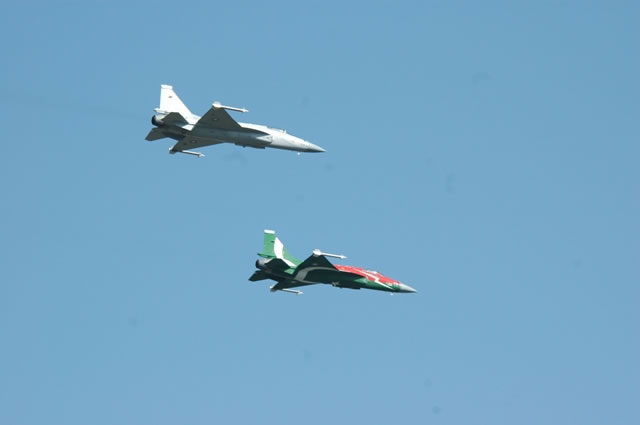
Pakistani JF-17 Thunders during fly past of National Day Joint Services Parade. I shot this picture myself.
Source
Originally from en.wikipedia; description page is/was here.
Date
2007-03-23 (original upload date)
Author
Original uploader was Faizanbokhari at en.wikipedia(I shot this picture myself.)
Permission(Reusing this image)
Released into the public domain (by the author).

[edit] License information
This image has been (or is hereby) released into the public domain by its author, Faizanbokhari at the wikipedia project. This applies worldwide.
In case this is not legally possible:Faizanbokhari grants anyone the right to use this work for any purpose, without any conditions, unless such conditions are required by law.
Afrikaans Alemannisch Aragonés العربية Asturianu Български Беларуская (тарашкевіца) Català Cebuano Česky Cymraeg Dansk Deutsch Ελληνικά English Español Esperanto Eesti Euskara Estremeñu فارسی Français Galego ქართული 한국어 हिन्दी Hrvatski Ido Bahasa Indonesia Íslenska Italiano עברית Kurdî / كوردی Latina Lietuvių Latviešu Magyar Македонски Bahasa Melayu Plattdüütsch Nederlands ‪Norsk (bokmål)‬ ‪Norsk (nynorsk)‬ 日本語 Polski Português Ripoarisch Română Русский Shqip Slovenčina Slovenščina Српски / Srpski Suomi Svenska ไทย Tagalog Türkçe Українська Tiếng Việt Walon ‪中文(简体)‬ ‪中文(繁體)‬ zh-yue-hant +/-

[edit] Original upload log
(All user names refer to en.wikipedia)
2007-03-23 08:47 Faizanbokhari 640×425×8 (10037 bytes) i shoot this picture myself.

[edit] File history
date/time
username
resolution
size
edit summary
05:17, 25 July 2007
User:WonYong
640×425
10 KB
File history
Click on a date/time to view the file as it appeared at that time. (Latest Earliest) View (newer 50) (older 50) (20 50 100 250 500)
Date/Time
Thumbnail
Dimensions
User
Comment
current
17:09, 24 February 2008

640×425 (10 KB)
BetacommandBot
(move approved by: User:GeorgHH This image was moved from Image:14004096 200703230833355477800.jpg {{Information Description=Pakistani JF-17 Thunders during fly past of National Day Joint Services Parade. I shot this pictur)(Latest Earliest) View (newer 50) (older 50) (20 50 100 250 500)
File links
The following pages on the English Wikipedia link to this file (pages on other projects are not listed):
Military of Pakistan
Pakistan Air Force
People's Liberation Army Air Force
Pakistan and weapons of mass destruction
JF-17 Thunder
List of aircraft of the Pakistan Air Force
Flypast
Republic Day (Pakistan)
Retrieved from "http://en.wikipedia.org/wiki/File:Two_JF-17_Thunders.jpg"

Cargo Aircraft


Cargo Aircraft


Aircraft in the Cargo segment are a wide range of aircraft suitable for all kinds of cargo flights, short-, medium- and long-haul. Aircraft with capacities to carry any type of cargo. Ranging from smaller aircraft performing short notice flights carrying vital spare parts up to large cargo aircraft able to transport any volumnious goodsClick on the links below or use the navigation panel to the left to browse the aircraft types available for charter! We supply all kinds of aircraft types for all kinds of missions. Anytime you need them. Anywhere you want them.

Airbus A300
AS 332L Super Puma
HS748 Cargo
Antonov AN-12
AS 365 N2 Dauphin
Lockheed Electra
Antonov AN-124
Boeing 707
Ilyushin IL76
Antonov AN-22
Casa 212
Merlin 4 A
Antonov AN-26
Embraer 120 Brasilia
Shorts Belfast
Antonov AN-32
Fokker F-27


Click here if you are missing navigation panel to the left!Send mail to webmaster@airbroker.se with questions or comments about this web site.Copyright © 1998 Air Broker Center

Airliners


Aircraft in the Airliner segment are large jet aircraft suitable for all kinds of flights. Aircraft capacity ranging from 50 to 400 passengers.Click on the links below or use the navigation panel to the left to browse the aircraft types available for charter! We supply all kinds of aircraft types for all kinds of missions. Anytime you need them. Anywhere you want them.

Airbus A300
Boeing 737-800
DC-9-21
Airbus A319
Boeing 747-200
DC-9-41
Airbus A320
Boeing 747-300
DC-9-51
Airbus A321
Boeing 747-400
Embraer 145
Airbus A330
Boeing 757
Fokker F-28
Airbus A340
Boeing 757 VIP
Fokker 100
Boeing Business Jet
Boeing 767
Fokker 70
Boeing 727-200
Boeing 777
Lockheed 1011
Boeing 727-VIP
BAC 1-11
MD-11
Boeing 737 300
BAe-146
MD-80/81/82/83
Boeing 737-400
Canadair RJ 200
MD-87
Boeing 737-500
Canadair RJ 700
MD-90

DC-10-30

Click here if you are missing navigation panel to the left!Send mail to webmaster@airbroker.se with questions or comments about this web site.Copyright © 1998 Air Broker Center

Turboprops


Aircraft in the Turboprop segment are a wide range of aircraft suitable for short and medium distance flights with a duration of up to 2-4 hours. Aircraft capacity ranging from 4 to 70 passengers.Click on the links below or use the navigation panel to the left to browse the aircraft types available for charter! We supply all kinds of aircraft types for all kinds of missions. Anytime you need them. Anywhere you want them.

ATR-42
Casa 212-200
Jetstream 61 ATP
ATR-72
Dash 8-100
Merlin III
Embraer Bandeirante
Dornier 228
Metro II
Beech King Air 100
Dornier 328
Metro III
Beech 1900
Fokker F27-100
Mitsubishi MU-2
Beech King Air 200
Fokker F27-200
Piper Cheyenne II
Beech King Air 300
Fokker 50
SAAB 2000
Beech King Air 350
Jetstream 31
SAAB SF-340
Embraer 120 Brasilia
Jetstream 41
Shorts SD360


Click here if you are missing navigation panel to the left!Send mail to webmaster@airbroker.se with questions or comments about this web site.Copyright © 1998 Air Broker Center

Executive Jets


Executive Jets
Aircraft in the Executive Jet segment are the most time efficient way of travel, suitable for medium or long distance flights. Business executives worldwide think of a business jet as a way to gain a competitive edge and expand their business horizons. Aircraft capacity ranging from 4 to 16 passengers.Click on the links below or use the navigation panel to the left to browse the aircraft types available for charter! We supply all kinds of aircraft types for all kinds of missions. Anytime you need them. Anywhere you want them.

Beechjet 400 A
Corvette
Gulfstream GV
Cessna Citation 500
Falcon 10
Gulfstream G 550
Cessna Citation 550
Falcon 100
Hawker Siddeley HS-125
Cessna Citation 560
Falcon 20
Learjet 31 A
Cessna Citation 650
Falcon 2000
Learjet 35
Cessna Citation Bravo
Falcon 50
Learjet 45
Cessna Citation SII
Falcon 900
Learjet 55
Cessna Citation Excel
Gulfstream GIII
Learjet 60
Challenger CL601
Gulfstream GIV SP

Click here if you are missing navigation panel to the left!Send mail to webmaster@airbroker.se with questions or comments about this web site.Copyright © 1998 Air Broker Center

Executive Jets


Aircraft in the Executive Jet segment are the most time efficient way of travel, suitable for medium or long distance flights. Business executives worldwide think of a business jet as a way to gain a competitive edge and expand their business horizons. Aircraft capacity ranging from 4 to 16 passengers.Click on the links below or use the navigation panel to the left to browse the aircraft types available for charter! We supply all kinds of aircraft types for all kinds of missions. Anytime you need them. Anywhere you want them.

Sikorsky S76


One in the wide range of aircraft types available through Air Broker Center
Passenger capacity: 12


Click here if you are missing navigation panel to the left!Send mail to webmaster@airbroker.se with questions or comments about this web site.Copyright © 1998 Air Broker Center

Ecureuil AS350


One in the wide range of aircraft types available through Air Broker Center
Passenger capacity: 5


Manufacturer's fact sheet BK 117 BO 105 EC 120 EC 135 EC 155B Ecurueil Dauphin Super Puma
Click here if you are missing navigation panel to the left!Send mail to webmaster@airbroker.se with questions or comments about this web site.Copyright © 1998 Air Broker Center